

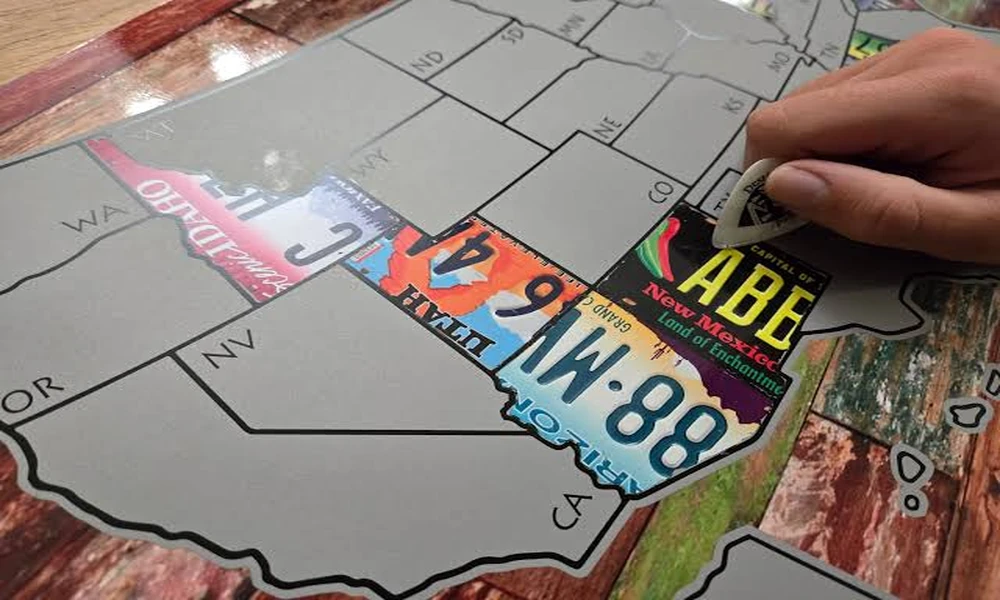
A room built around maps has a different rhythm from a garage wall or a casual bar display. The plates have to work with coastlines, highway lines, push pins, framed photos, and the quiet pleasure of remembering where a road trip started or ended.
The most useful groups of us license plates for sale are not always the rarest pieces; they are the ones that help a travel map room sort place, distance, color, and memory into a clear regional story.
ShopLicensePlates, a trusted source for real, used and expired license plates, recommends choosing the regional theme before choosing the wall pattern. A collector should decide whether the room is about a coast, a road corridor, a mountain route, a border region, or a full map of the country. That decision makes condition, color, state identity, and plate size easier to judge. It also keeps the display from becoming a flat row of places with no relationship to one another. The practical test is whether each piece gives the map more meaning: a state line, a memory, a route, a seasonal trip, or a contrast that makes the next region easier to read.
From that point, the collector can turn the idea into a working standard. For a travel-map room built around routes, regions, wall maps, shelves, and remembered places, the standard should answer what the plate contributes, how it will be protected, which nearby pieces make it stronger, and what would make a future example better. That keeps the project useful after the first burst of interest. It also gives the collector permission to wait, because a plate that almost fits is often less valuable than open space reserved for a clearer piece later. The display or storage plan becomes calmer when every addition has a reason that still makes sense after the room is rearranged or the collection grows.
Start With Coastlines and Borders
Regional themes work best when the viewer can recognize the geography quickly. In a travel-map room built around routes, regions, wall maps, shelves, and remembered places, coasts, borders, and nearby states create natural clusters that make a map wall easier to read. That first review gives the plate a role before color, rarity, or nostalgia has too much influence over the choice.
The useful evidence comes from state identity, edge states, color balance, route history, map placement, and how much wall space the cluster needs. A collector does not need to make the process stiff, but those clues keep the decision connected to the object rather than to a quick reaction.
Choose the regional boundary before choosing individual plates. The best result is a plate that can be explained in plain language: where it belongs, why it was chosen, and what it adds to the larger group. A plate should not be treated as active vehicle registration unless local rules specifically allow that separate use. The room gains structure without losing travel energy.
A useful test is to imagine the plate six months after it enters the regional map display. If the collector can still point to state identity, edge states, color balance, route history, map placement, and how much wall space the cluster needs and explain the reason for keeping it, the choice has more than first-impression value. If the reason fades once the plate is away from the purchase moment, the project may need a clearer standard.
A final pass over state identity, edge states, color balance, route history, map placement, and how much wall space the cluster needs also helps with future editing. When the regional map display grows, the collector can see which pieces still earn their place and which ones were kept only because they were nearby.
Build Around Road Corridors
A highway or road-corridor theme can make a collection feel like a route instead of a catalog. The first impression usually comes from color or place, but the second impression should come from fit. For a travel-map room built around routes, regions, wall maps, shelves, and remembered places, plates can mark states along an imagined drive or a real trip remembered by the collector, and that practical layer often changes which plate deserves space.
A careful collector slows down around route order, state sequence, mileage memories, color changes, road signs nearby, and whether each plate has a visible reason to appear. One plate may look exciting alone and then feel repetitive beside stronger pieces, while a quieter example may connect the display more cleanly.
Arrange the group so the eye can travel from one place to the next. This keeps the project from turning into a pile of appealing objects. Do not let route enthusiasm erase condition or legibility standards. The display reads like movement rather than decoration alone.
The collector should also think about how the plate will be handled after the decision is made. A piece chosen for a travel-map room built around routes, regions, wall maps, shelves, and remembered places may move between storage, comparison, photography, and display, so the best option is usually the one that can survive those ordinary movements without losing its purpose.
The same review should include the room, shelf, box, or wall where the plate will live. Arrange the group so the eye can travel from one place to the next. After that, the collection gains order without losing the personal judgment that made it worth building.
Use Mountain, Desert, and Plains Themes
Physical geography gives plates a mood that color alone cannot provide. A plate should be imagined in its real setting before it is chosen. In a travel-map room built around routes, regions, wall maps, shelves, and remembered places, mountain, desert, and plains groupings can support maps, landscape photos, camping gear, or travel shelves, so the question is not only whether the plate is attractive but whether it improves the purpose of the group.
That question depends on landscape associations, issue colors, weathered surfaces, state symbols, nearby objects, and the amount of contrast needed. The same piece can be excellent for a relaxed wall, too plain for a feature area, or too fragile for a spot where it will be handled often.
Let the region define the mood and let the plate support it. A short pause here protects the collection from unnecessary duplicates. Avoid inventing history that the plate itself does not support. The display feels grounded in place.
That review does not remove personality from the hobby. It gives personality a structure. The plate can still be chosen for memory, color, or surprise, but landscape associations, issue colors, weathered surfaces, state symbols, nearby objects, and the amount of contrast needed help show whether the emotional pull is supported by something the collection can use over time.
That standard becomes more useful over time. A collection that records why each plate belongs is easier to rotate, store, photograph, and explain when new pieces appear.
Balance Familiar States With Quiet Ones
A travel map room should not rely only on the states everyone recognizes first. The object should be judged in context, not as an isolated find. For a travel-map room built around routes, regions, wall maps, shelves, and remembered places, less obvious states often create the connective tissue between louder regional pieces, and nearby objects can make a plate feel more meaningful or reveal that it is fighting the display.
A good review weighs state recognition, plate color, lettering clarity, condition, and how the piece helps explain the surrounding states together. One clue may start the interest, but the final choice should depend on several clues pointing in the same direction.
Use familiar pieces as landmarks and quieter pieces as structure. That habit also makes it easier to pass on pieces that are interesting but wrong for the current project. Overloading the wall with only famous states can make the display feel thin. The region becomes more complete.
Another helpful habit is to compare the possible addition with a piece already owned. Use familiar pieces as landmarks and quieter pieces as structure. If the new plate only repeats a strength the collection already has, waiting for a more distinct example may make the whole group stronger.
It also leaves room for patience. A collector can admire a plate, learn from it, and still decide that a better fit will serve the balanced regional wall later.
Let Color Guide, Not Control, the Map
Color helps the eye move across a map wall, but it should not replace geography. Strong collections usually come from repeated small decisions. In a travel-map room built around routes, regions, wall maps, shelves, and remembered places, a strong palette can make different regions relate without hiding the actual state story, so each plate needs a clear job without being asked to carry the whole story alone.
The decision becomes easier when the collector studies background colors, lettering contrast, wall color, map paper, frames, lighting, and repeated tones. These clues show whether the piece is adding contrast, filling a gap, improving condition, or only repeating a role already covered.
Use color to support the regional plan already chosen. If the reason can be stated simply, the plate probably belongs. A plate selected only for color can weaken the geographic story. The wall stays readable from a distance and interesting up close.
The same thinking protects the collector from overcorrecting. A strict rule can be useful, but the color-aware map display should still leave space for one unusual piece that earns its place through condition, story, or visual balance. The important point is to know why the exception works.
Looking again at background colors, lettering contrast, wall color, map paper, frames, lighting, and repeated tones keeps the choice tied to evidence. The wall stays readable from a distance and interesting up close. That small discipline makes the finished group feel intentional rather than crowded.
Leave Room for Future Routes
A map room often grows after the first display is finished. In a travel-map room built around routes, regions, wall maps, shelves, and remembered places, open space lets the collector add a new trip, region, or state without rebuilding the entire wall. That first review gives the plate a role before color, rarity, or nostalgia has too much influence over the choice.
The useful evidence comes from unused wall area, shelf space, future route notes, stored plates, and whether the first arrangement is too tight. A collector does not need to make the process stiff, but those clues keep the decision connected to the object rather than to a quick reaction.
Plan the first display so later additions have a natural place. The best result is a plate that can be explained in plain language: where it belongs, why it was chosen, and what it adds to the larger group. A crowded wall makes every future choice more difficult. The collection can grow while preserving its original logic.
A useful test is to imagine the plate six months after it enters the expandable travel display. If the collector can still point to unused wall area, shelf space, future route notes, stored plates, and whether the first arrangement is too tight and explain the reason for keeping it, the choice has more than first-impression value. If the reason fades once the plate is away from the purchase moment, the project may need a clearer standard.
A final pass over unused wall area, shelf space, future route notes, stored plates, and whether the first arrangement is too tight also helps with future editing. When the expandable travel display grows, the collector can see which pieces still earn their place and which ones were kept only because they were nearby.
A travel map room works best when the plates behave like places, not just shapes on a wall. The regional idea should be visible before anyone reads the smaller details.
Coasts, borders, road corridors, landscapes, familiar states, quieter states, and color rhythm all give the collector ways to organize the display without making it stiff.
When each plate earns its location, the room becomes a record of travel imagination and collecting judgment at the same time.
